How I Scored 90 in All Bands on the PTE | My Journey, Strategy & Tips
If my TikTok video on PTE Tips Part 1 brought you here, please let me know in the comments below. It will help me understand how I can share more helpful information in the future :)
Anyhooo, hello there and welcome to my blog. As I mentioned on TikTok, I finally had the time to compile all the resources and tips I used when I studied for my PTE Exam. I took the PTE because I needed it for my 485 Temporary Graduate Visa here in Perth.
At first, I honestly felt overwhelmed. There were so many tips on YouTube, so many “templates,” and so much pressure to get a high score. I even asked myself a few times, “Kaya ko ba ‘to?” Especially because during that time, I was juggling school, work, and finding time to review for PTE.
But after consistent practice and mindset work, praise God, I scored 90 in all bands. That moment felt so surreal. I cried. I celebrated quietly. And I thanked myself for not giving up.
Today, I want to share everything I learned so you can feel confident taking your PTE too.
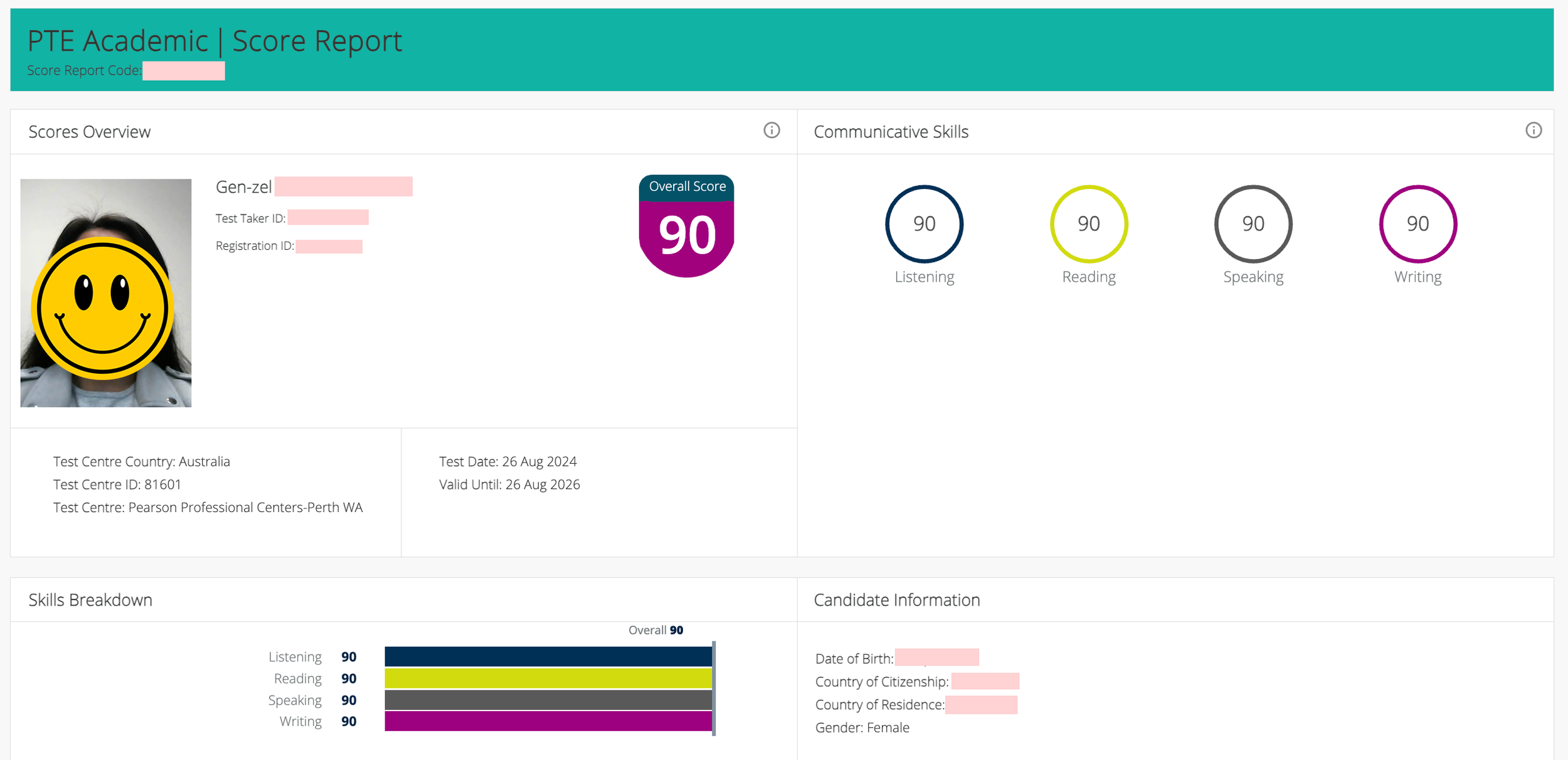
I only had 3 days to prepare. And since I know I work best under pressure, I dedicated one full day (Sunday) to really study, which was a day before the exam (Monday).
I watched a lot of YouTube videos and some reviewers from the PTE website (I will list all the links on this post). But I realized that what helped me the most was taking as many mock tests as I could.

The only app I used was APEUni. I purchased the VIP 30 Days for AUD 24.95 and for me, that was already enough. You’ll get unlimited mock tests, but do not rely on the scores because they are not very accurate. Use the app mainly to familiarize yourself with the flow of the exam.
This helps a lot because on the actual exam day, you already know what to expect. You’ll feel more confident and relaxed. I also noticed that there were about 2 to 3 questions from APEUni that appeared in my real PTE test.
So where should you focus the most?
1. Speaking
Read Aloud
Repeat Sentence
Describe Image
Retell Lecture
2. Writing
Summarize Written Text
Essay
3. Reading
Reading - Fill in the Blanks
Reading and Writing - Fill in the Blanks
4. Listening
Write from Dictation (super important)
These are high scoring tasks that quietly boost your overall score.
Repeat Sentence (Speaking)
Read Aloud (Speaking)
Write from Dictation (Listening)
Reading and Writing: Fill in the Blanks
Task-by-task Tips
Speaking
Don’t pause more than 3 seconds
Speak like you’re talking to someone kindly and calmly
Microphone slightly below the lips
Repeat Sentence
This is the highest scoring task in the whole exam.
Goal: Copy the tone and rhythm, not every single word.Tips:
• Do not try to memorize. Let the sentence flow through you.
• Focus on the intonation. Say it how you hear it.
• If you forget words, keep the sentence structure.
• If confused, repeat the first half confidently rather than freezing.Practice: 10 to 20 sentences daily.
Read Aloud
This boosts both Speaking and Reading.
Tips:
• Speak naturally. Not too fast. Not too slow.
• Keep your voice calm and steady.
• Do not pause for more than 2 seconds.
• Smile slightly to open your tone.
• Look ahead with your eyes so your mouth never gets stuck.Describe Image
Your score is for fluency, not content.
Simple Template to Use:
"This image shows the topic of (title or main subject).
There are several key points visible.
Overall, the image provides useful information about the topic."You do not need to mention numbers or details unless it feels natural.
Maintain consistency of speechRetell Lecture
Use keywords and abbreviations in writing notes. Fluency matters more than detail.
Listen for the main topic and two supporting points.
Take quick notes with short keywords only.
Do not try to replay the whole lecture.
You can start with:
The speaker is talking about
She discussed,
She tackled,
She mentioned,
She also talked aboutTemplate
"The lecture talks about (main idea).
The speaker explains that (point 1).
Additionally, it mentions (point 2).
In conclusion, the lecture focuses on (main idea repeated)."
Writing
1. Summarize Written Text
One sentence only.
Structure:
Main idea + connecting phrase + supporting detail.
Use connecting words like "which", "that", "and", "while".
Example structure:
"The passage discusses (main idea) which explains (key supporting point)."
Do not overthink vocabulary. Clarity is the priority.
2. Essay
Use a very simple structure.
Paragraph 1: Introduction
Paragraph 2: Example or explanation
Paragraph 3: Second example or explanation
Paragraph 4: Conclusion
Focus on being clear and organized.
Do not try to sound fancy.
Reading
1. Reading & Writing Fill in the Blanks
This is vocabulary and collocations.
Tips:
• Learn how words pair naturally.
For example:
"commit a crime"
"deep sleep"
"raise awareness"
Use the ApeUni collocation list. Practice daily.
2. Reading Fill in the Blanks
Trust your instinct when choosing words.
If unsure, think of what sounds natural in everyday English.
3. Reorder Paragraphs
Look for:
• Pronouns (he, she, they)
• Sequence words (first, then, however)
• Topic sentence usually stands alone
• Support sentences refer back to the topic
Listening
1. Write From Dictation
This is a huge scoring task.
Tips:
• Train your ear + typing together.
• Always get the structure correct first.
• If you forget a word, fill with a grammatically fitting word rather than leaving a gap.
Practice: 10 to 20 everyday until your exam.
2. Summarize Spoken Text
Use the same structure as Retell Lecture.
Focus on the main idea and two key points.
Finally, remember:
Your score is based on:
• Fluency
• Confidence
• Consistency
Not perfect grammar or perfect memory.
Speak like you are guiding someone kindly and calmly.
Do not rush. Do not freeze. Do not chase perfection.
Why Most Students Get Stuck at 60–70
They spend too much time on:
Essay templates
Summarize Written Text
Multiple-choice questions
These are low scoring.
Instead, put 80% of your energy into:
Repeat Sentence
Read Aloud
Write From Dictation
Fill in the Blanks
This is how you score fast & score high.
Before the Exam
Do at least one full mock test.
Practice speaking out loud, not silently.
Sleep well. Your brain needs to be fresh.
Use the same type of headset if practicing at home.
On the Day of the Exam
Arrive early to settle your energy.
Don’t drink too much water before speaking
During speaking, everyone around you is noisy — ignore it and stay in your flow.
If you make a mistake, do not stop. Just continue.
This exam is not about being perfect. It’s about clarity, consistency, and calmness.
If you’re preparing for the PTE right now, I just want to say:
“You are capable.
You don’t have to sound “native” to score high.
You just need strategy, consistency, and belief in yourself.
You got this. I’m cheering for you!”